Have you ever wanted to display neat, organized data right in your console using C? Creating a table in a console might seem tricky at first, but with the right steps, you can make your output clear and professional.
You’ll learn simple techniques to build tables that grab attention and make your data easy to read. Whether you’re coding for a project or just improving your skills, mastering this will give your programs a powerful edge. Keep reading, and you’ll be able to create clean, structured tables in no time!

Credit: www.amazon.com
Setting Up Your Environment
Before creating a table in a console using C, set up your environment. This step ensures smooth coding and fewer errors. A proper setup saves time and effort. It helps you focus on writing the code, not fixing issues.
Choosing The Right Compiler
Pick a compiler that suits your needs. Popular options include GCC, Clang, and Microsoft Visual C++. GCC works well on Linux and Windows through MinGW. Clang is fast and supports many platforms. Visual C++ integrates with Windows easily.
Check if the compiler supports your system. Some compilers need installation before use. Others come bundled with IDEs like Code::Blocks or Visual Studio. A good compiler catches mistakes early. This helps you write cleaner code for your console table.
Preparing Your Workspace
Create a dedicated folder for your project. Keep all files organized in one place. This avoids confusion and lost files. Use a simple text editor or an IDE to write your code.
Set up your editor to highlight C syntax. This makes reading and editing easier. Test your compiler by running a simple “Hello, World!” program. Confirm everything works before starting your table project.

Credit: www.lowes.com
Basic Console Output Techniques
Creating a table in a console using C requires understanding basic output methods. These methods help display data clearly and neatly. This section explains simple ways to print and organize text in the console. You will learn to format output and control where text appears on the screen.
Using Printf For Formatting
The printf function prints text and values to the console. It can format numbers, strings, and characters. Use format specifiers like %d for integers and %s for strings. Set width and alignment to create columns. For example, %10s prints a string in a 10-character wide field.
Adding spaces or dashes fills the gap between columns. This alignment keeps the table neat and easy to read. You can also control decimal places for floating numbers with %.2f. This prints two digits after the decimal point.
Controlling Cursor Position
Controlling the cursor position allows precise placement of text. The console cursor moves automatically with each print command. You can reset it using special functions or escape sequences.
Using ANSI escape codes, you can move the cursor anywhere on the screen. For example, \033[10;5H moves the cursor to row 10, column 5. This helps place table cells exactly where you want.
Clear the screen or parts of it to refresh the table. This technique is useful for dynamic tables that update frequently. Cursor control makes your console output look cleaner and more professional.
Designing The Table Layout
Designing the table layout is the first step in creating a clear and readable console table with C. A well-planned layout helps organize the data and makes the output visually appealing. Planning involves deciding on the number of rows and columns and how the table will look with borders and separators. These choices affect the table’s readability and structure.
Determining Rows And Columns
Start by deciding how many rows and columns your table needs. Rows represent the number of data entries or items. Columns organize data into categories or fields. Keep the table size manageable for the console screen. Avoid too many columns; it can make the table hard to read. Count the data points to know the exact rows and columns required. This step helps set clear boundaries for your table.
Choosing Borders And Separators
Borders and separators divide the table into cells and improve readability. Use simple characters like |, -, and + for borders. These characters are easy to print and understand. Choose consistent separators between columns and rows. Clear borders help users quickly scan the table. Avoid complex or heavy characters that might not display well in all consoles. Clean, simple lines keep the table neat and professional.
Creating Table Borders
Creating table borders in a C console program helps organize data clearly. Borders make the table easier to read and understand. You build these borders using characters like dashes and pipes. These characters form horizontal and vertical lines that frame your table.
Drawing Horizontal Lines
Horizontal lines separate the rows in your table. Use a loop to print a series of dashes (-). Match the line length to your table width. This keeps the table neat and consistent. You can print a horizontal line before and after each row.
Example code:
for (int i = 0; i < width; i++) { printf("-"); } printf("\n"); Adding Vertical Lines
Vertical lines separate the columns in your table. Use the pipe character (|) to mark column edges. Print this character before each column value. This creates clear divisions between data fields.
Example code:
printf("| %s | %s | %s |\n", col1, col2, col3); Filling Table Cells
Filling table cells in a console using C requires careful planning. Each cell must hold content clearly and neatly. The goal is to make the table easy to read. This means text inside cells should align well and handle different content lengths smoothly.
Simple techniques help make the table look clean. You can control how text sits inside each cell. You can also manage how long or short the content is. These steps improve the overall display of your console table.
Aligning Text Within Cells
Aligning text inside cells helps improve readability. You can align text to the left, right, or center. Use spaces to move text to the correct spot. For example, to center text, add spaces before and after it. This way, the text looks balanced inside the cell.
In C, you can use loops to print spaces. This shifts the text to the desired position. Aligning text consistently makes the table look professional. It also helps users scan the data quickly.
Handling Variable Content Lengths
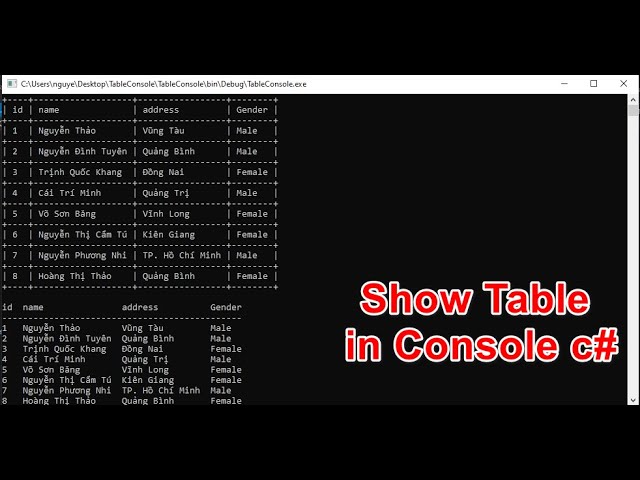
Content length varies in each cell. Some cells may have short text, others long. To keep the table aligned, set a fixed width for each cell. If the text is shorter, add spaces to fill the cell. If the text is longer, cut it or wrap it carefully.
Using fixed widths avoids messy columns. It keeps the table structure clear. You can use functions like strlen() to check text length. Then, adjust spaces or trim text based on this length. This method keeps the table tidy and readable.
Credit: www.youtube.com
Enhancing Table Appearance
Enhancing the appearance of a table in a C console program makes the output clearer and more attractive. A well-designed table helps users read data quickly and understand it better. Simple techniques can improve the look without complex coding. Using colors and adding headers or footers are effective ways to enhance your table’s style.
Using Colors In Console
Colors make tables more readable and help highlight important parts. In C, you can use ANSI escape codes to change text color. For example, use \x1b[31m for red and \x1b[0m to reset the color. Apply colors to headers or specific cells to separate them visually. Keep colors simple to avoid confusion. Use contrasting colors for better visibility on different backgrounds.
Adding Headers And Footers
Headers give titles to columns, making the table easier to understand. Place the headers on top with clear labels. Use lines or characters like dashes and pipes to separate headers from data rows. Footers can show totals or summaries at the bottom. They add useful information and complete the table. Both headers and footers structure the table and improve user experience.
Common Mistakes To Avoid
Creating a table in a console using C can be tricky. Many beginners face common issues that affect the table’s look and clarity. Avoiding these mistakes ensures your table looks neat and professional. Focus on key details like borders and text alignment.
Mismatched Borders
One frequent mistake is mismatched borders. This happens when the lines do not connect properly. It makes the table look broken or messy. Use consistent characters for corners and edges. Check that vertical and horizontal lines align perfectly.
Test your table with different screen sizes. Some characters may render differently on various consoles. Fix any uneven or missing border parts before finalizing your code.
Incorrect Text Alignment
Text alignment inside table cells is important. Poor alignment makes data hard to read. Always center or left-align text based on your table’s design. Use fixed-width columns to keep alignment steady.
Calculate the space each cell needs. Add padding or spaces to balance the text. Avoid mixing alignments in the same column. Consistency improves readability and overall appearance.
Sample Code Walkthrough
This section walks you through a simple C program that creates a table in the console. Step by step, you will see how the code builds the table. Understanding each part helps you write your own tables later.
The example uses basic C commands. It shows how to print rows and columns neatly. This guide makes it easy to follow even if you are new to C programming.
Step-by-step Code Explanation
First, the program includes the standard input-output library. This library allows printing to the console. Next, the main function starts the program.
The code uses loops to print the table rows and columns. The outer loop controls the number of rows. The inner loop prints each column in a row.
Inside the inner loop, the program prints table cells with a fixed width. This keeps columns aligned. A separator character, like a pipe (|), divides the columns.
After printing all columns in a row, the program moves to the next line. This creates the table’s row structure. The process repeats until all rows are printed.
Running And Testing Your Table
Save the program with a .c extension. Use a C compiler to compile the code. If no errors appear, the program is ready to run.
Run the executable file in your console or terminal. You should see the table printed with rows and columns aligned. Check the output for any misalignment or mistakes.
Try changing the number of rows or columns in the code. Recompile and run again to see the updates. Testing helps you understand how the loops control the table size.
This practice improves your skills in console output formatting. You can create different table styles using similar code.
Frequently Asked Questions
How Do I Create A Simple Table In C Console?
To create a table in C console, use loops to print rows and columns. Format cells with spaces or characters for alignment. Use printf for output and control layout with tabs or fixed width.
What Libraries Help In Making Console Tables In C?
Standard C uses stdio. h for console output. For advanced formatting, libraries like ncurses provide better control over console tables and UI elements in C.
How Can I Align Text In Console Table Columns?
Align text by setting fixed column widths using printf format specifiers. Use left or right alignment flags to keep table data tidy and readable.
Can I Add Borders To Tables In C Console Output?
Yes, use characters like |, -, and + to draw borders manually. Combine them with loops to build the table’s frame around the data.
Conclusion
Creating a table in a console with C is simple and useful. You learned how to print rows and columns clearly. Using loops and format specifiers helps keep things neat. Practice writing different tables to get comfortable. This skill can improve your coding projects.
Keep experimenting and enjoy coding in C!

